The state of climate biotech: what the community told us
In May, Homeworld’s incoming Executive Director Paul Himmelstein sent this appeal out to the climate biotech community:
“When Homeworld was founded, Dan and Paul talked to hundreds of biotechnologists to shape the original focus of our work. We’re doing it again, this time as a formal survey. The science and technology landscape has changed since 2022, and we want to ensure the emerging needs of our community and field are reflected in our strategy going forward. Your feedback will directly shape what Homeworld builds next and how we support the field over the next few years.”
We are excited to share the results of our collective effort.
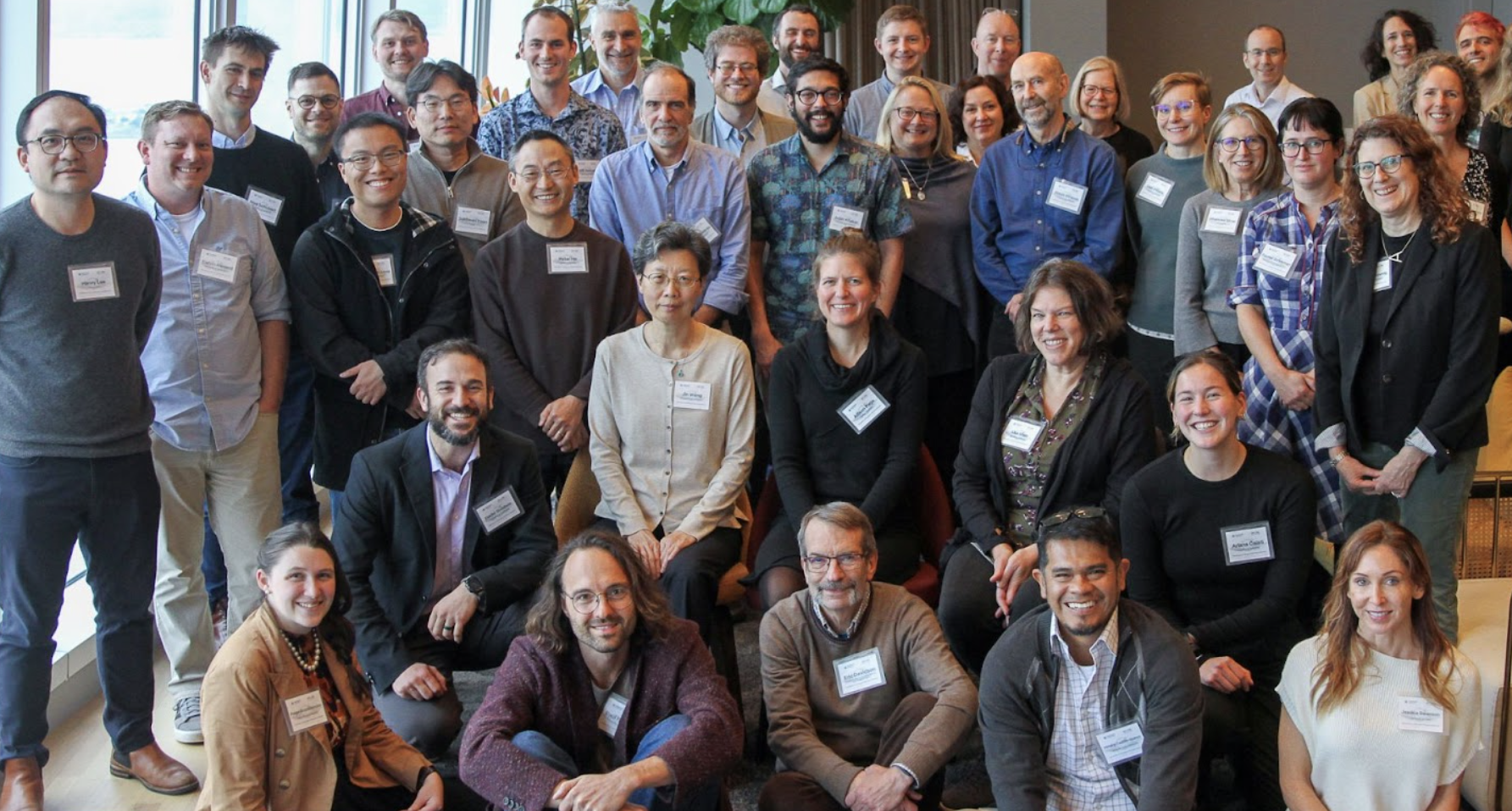
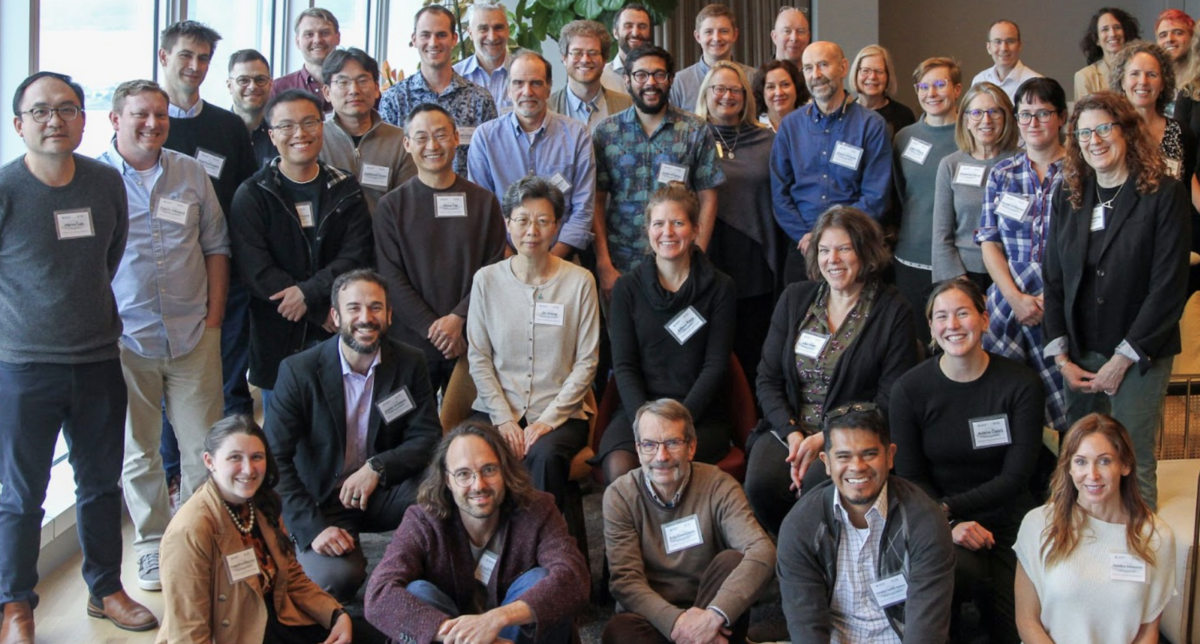
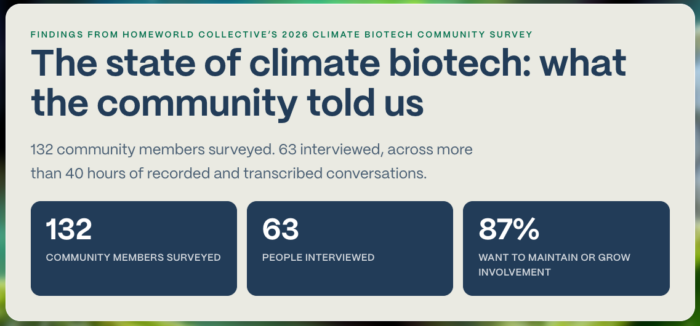
Over the past several months, we surveyed more than 130 people working in or adjacent to climate biotech and interviewed 63 of them, across more than 40 hours of recorded conversations.
We are publishing the findings today, along with an interactive dashboard so you can review the data yourself. We took on this project to design what Homeworld builds next, and as a resource for others sharpening what they build. We hope everyone interacts with the data and continues to provide feedback if we missed something, or you feel our categorization could be changed.
What the field needs: Capital of various sizes, and fieldbuilding infrastructure
In the questionnaire, we asked community members to name the resources that would most help them apply their work to planetary health. Two distinct gaps came up:
- Funding: 57% named funding to de-risk and explore ideas under $100k. 56% named funding to build on de-risked ideas above $100k. This includes small, fast capital to test whether an idea is real, which is a different instrument from the capital that carries a proven idea to scale.
- Field-building: clearer problem definition (41%), connections to industry (34%), and working groups or consortia (31%).
There were some notable differences between sub-groups. Academics were far more likely to want the small early de-risking check (71% versus 44% at startups). Startups were more likely to need lab access (34% versus 10% in academia). That said, the need for industry connection and translation know-how was close to universal across both demographics.
Scaling work from the lab to the world is the hardest part
Through our interviews, another gap emerged by a wide margin: 49 of 63 interviewees named the difficulty of getting work to survive outside the lab, whether due to market traction, heterogeneous real-world conditions, regulatory hurdles, and a black box of industrial realities.
More than four in five interviewees (83%) raised the economics of scaling as a core worry. Can this work at a cost anyone will pay at scale? More than half (54%) pointed to missing industry connections, and commonly shared issues were a lack of both techno-economic intuition and real insight into industrial conditions.
“Learning to think more like a chemical engineer about scale and techno-economics, that’s the bottleneck on getting conviction for a scalable idea.”
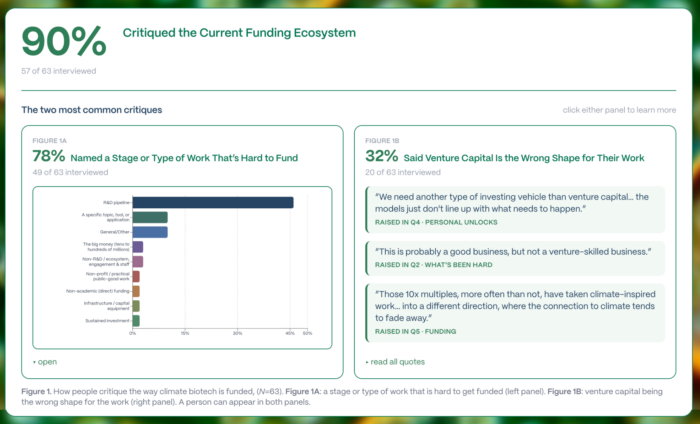
The capital does not always fit the work either. Over a quarter of interviewees said venture funding is the wrong shape for much of climate biotech, with timelines and return expectations built for software rather than biology.
“Once we learned more about the technology pathways and the business pathways, we realized, ‘This is probably a good business, but not a venture-skilled business.’ And so there is that gap between the venture-backed startup and a good self-sustaining idea and business, but not venture-backable, thus the scaling capital or the initial capital is very not clear.”
Also, many said that bioscientists are not willing enough to interrogate whether biology is even the right tool for a given job. Researchers described conferences where chemistry and biology sit on opposite sides of the room, and how that siloing narrows what any of us can build.
At Homeworld, we view this as an opportunity to build interdisciplinarity, not as a condemnation of biosciences but as a legacy feature to overcome.
Too few paid jobs keep people out of the field
When we asked what would let people do more, a striking number answered that there is simply not enough opportunity to get paid to do this work. This is distinct issue not necessarily solved through entrepreneurial culture. We can’t solve jobs by turning everyone into a founder. It is not about capital for new ventures or unlocking entrepreneurship, although those pieces will be a part of the overall solution for sure. Jobs are what let people stay in the field at all. There is a gravity well of pharma and therapeutics, in large part because that is where you can pay rent and support a family.
“Plenty of capable people are out there ready to help solve these problems if there were a way to pay them for it.”
What the community proposed on June 30
On June 30, we shared these findings live and then handed the floor to the community. Four breakout groups worked on what to actually do about the gaps, and their proposals were more concrete than anything we would have written alone. You can watch the recording here.
Some community-generated ideas that emerged were:
- A techno-economic analysis resource built for this field. Most TEA support is aimed at neither climate nor biotech, so it misses the nuance that matters here. The group proposed a guide with pieces you can interact with quickly, plus deeper models you can populate privately with your own data, since an early TEA can tell you something you may not want to publish. They also want to connect it back to community members with TEA experience who can offer a second pair of eyes.
- A community directory sorted by expertise and sector. So that someone working in biomining, for example, can see who else is in large companies, in startups, and in academia. The group emphasized that the most valuable connection is often academia to established industry, not just academia to startups.
- Structure for smaller-group connection, beyond asynchronous Slack. A lot of real connecting already happens in DMs, and people asked for more formats like the event they were in, ways to feel trusted enough to ask questions and actually get answers.
- A small, community-centered project around $15,000. The group focused on incremental improvements to existing technology, work that matters to the field but does not fit a venture vehicle, and where a nonprofit can usefully deploy small capital. A community hackathon was one idea.
What Homeworld is testing next
As we’ve mentioned, our goal with this project was to accurately design what Homeworld can build next to have the most impact.
We found a powerful starting point from this insight: Among people who have engaged with Homeworld, 86% of those who received a grant or attended a workshop said it changed the kind of work they thought was possible, compared with 52% for lighter touchpoints like Slack, the newsletter, or the podcast.
“The thing I’m going to really remember is engagement changes what’s possible. I never had that crystallized before, but it’s so true.”
We agree, engagement changes what’s possible. In this spirit, we are testing three programs against the needs above, through the end of 2026 and into 2027, to build the foundation for maximum engagement across our verticals:
- Homeworld Academy: Fundamentals in Biotech Translation and Climate Impact – Curriculum and support for moving work from the lab toward a real market, covering scaling intuition, judging which problems matter, and the industry connections most researchers lack.
- Community Ambassadors – Researchers embedded in their own cities and institutions, beyond Boston and San Francisco, who keep the community active and build momentum locally, so it sustains itself rather than depending on any single organization.
- Seedling Grants – Small, fast capital piloting at $5,000, so an early-career researcher can de-risk an idea and gain agency over their own research direction. This continues the Garden Grants line, which deployed over $3M across roughly 30 teams, to triangulate on an even more upstream approach with a high-leverage researcher profile.
Explore the data, and tell us what we missed
We invite you to dig into the data! The interactive dashboard lets you filter by sector, career stage, and involvement, build your own cross-tabs, and see how needs shift across the community. We built it so you can figure out what you want to build next, not just to support our conclusions.
If you find a mistake, we want to hear it. We did not pull punches aimed at ourselves in this analysis, and we would rather the numbers be right than flattering.
Watch the recording of our survey findings and presentation here:
Homeworld Collective is a nonprofit dedicated to helping bioscience practitioners deliver scalable technologies for planetary health. We foster community, build knowledge, and directly support early-stage research.